Fear the Wolf. Dread the Man.
By KUIU Staff

Rifle season, central Idaho, 2021
Opening morning, and a heavy 6x6 bull was doing everything you want to see. Working the timber edge on the far side of the basin, doing what a bull does when he doesn’t know he’s being watched. Tyler M. of Cheyenne, WY had glassed this same basin a year earlier when he notched his mule deer tag. He came back with a plan. And the plan was working.
BEFORE WE BEGIN
Let’s be clear about what this article isn’t.
Wolves have unquestionably hammered elk herds across the west. Recruitment is down, calf survival is down, whole areas have been restructured around a predator that wasn’t there a generation ago. That’s real, documented, and no hunter who’s watched it happen needs a study to try and persuade or dissuade it. This story is about the cards you’re holding when you hunt in wolf territory and the factors you control. Wolves do what they do. What you do is the part that’s hardly discussed.
THE TWO-LEGGED WOLF
A three-year study on the Clarks Fork herd near Cody, WY, collared both elk and wolves, and what they found tells you something about how elk respond, and how they recover. When wolves closed within about a half mile, elk did what you’d expect – they moved. After 2-3 days, elk will often resume their normal patterns.
Work out of Yellowstone adds to this. Elk don’t live in a state of constant terror from wolves. They manage the risk through time and space: avoiding dangerous places at dangerous times, then return when the threat cycles away. A wolf pack passing through is a time-and-place problem. The elk move, the dust settles, they resume.
Think of it as the highway trooper with a radar gun. You’re going ten over the limit, you see him, you hit the brakes and a mile down the road you’re back to speed. The trooper moves on. The wolf moves on. That’s a “coursing” predator. As long as it wasn’t a real hit on the herd, (or your driving record) it’s a problem that passes.
So when a pack ran his bull off the mountain, everything the studies suggest says the herd should have dropped into the nearest security cover, held up for a few days, and started filtering back.
But Tyler’s bull didn’t. And the reason it didn’t was walking around the basin in a pair of Attack pants with a .300 Win Mag, leaving scent on every thermal and boot tracks on every trail while trying to piece together a plan B.
So here is what really happened to Tyler. The wolves spooked the herd. A sharp, but temporary event, exactly the kind (living) elk are built to absorb and recover from. But the country they’d normally have scattered into already had a predator living in it. The camp in the drainage. The headlamp at four a.m. The daily noise through the basin, all staked down like a wolf that never leaves, never cycles away, never lets the dust settle. Multiplied by two, three, thirty when you factor in other hunters, and the herd was left with no choice but to find the furthest place from the wolves and Tyler. The wolves opened the wound. Hunters kept it from closing.
ACTIONS THAT KEEP ELK GONE
The deadfall-crashers who think they can pick through heavy timber quietly enough to catch a bedded bull. The country-crossers who cover eleven miles a day and forget they’re hunting. The all-day glassers who keep their eye in the spotter but ignore the wind. One of them is around you, and every one of them is sending elk the same signal: it’s danger season.
You Occupy the Refuge.
When pressure hits, elk don’t leave the country, they leave the chaos, escaping to safe spaces on their map: the steep ground, the dark timber, the drainages walled off by deadfall, the worst places they like to hide (and die), as hunters well know. Most hunters chase the scattered herd straight into that cover, turning the one place elk felt safe into place they don’t.
The rule: hunt the refuge like you’re not there, or don’t hunt it at all.
You Never Let the Dust Settle.
Disturbances are survivable precisely because they end. The wolves move on, the pressure lifts, and the elk filter back out. But a hunter who just watched his hunt blow up and grinds the country daily, resets the clock to zero every morning.
The rule: give the mountain a day or two of genuine quiet before you go back in.
You’re Loud in a Silent Space.
After a real disturbance, elk go quiet – and quiet is intel, not absence. The hunter who answers with a locator bugle every few hundred yards is broadcasting the exact signal that keeps pressured elk silent and moving.
The rule: go quiet when the country does.
You Ignore the Thermals That Carry You.
In high pressure units, control your wind and thermals, and do the same for other hunters you see in the field. To an elk reading his fear map, you’re not a predator that passed through. You’re part of an army that moved in.
The rule: check the wind first, every time, and treat your scent as the one thing that determines the outcome.
You Read the Wrong Autopsy.
A common mistake isn’t tactical, it’s diagnostic. Decide too soon the wolves blew out your hunt, and you quit the area, pack up and work toward a new area while the herd resettles under your nose, a half mile away.
The rule: assume the elk are still there, still close, still readable, until you’ve proven otherwise.
SHOP THE GEAR
Explore some of the products featured in the article.

1. Attack Pant
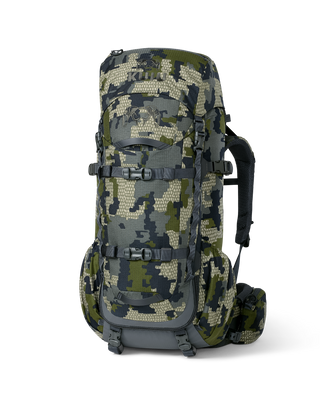
2. ICON 6 4500 Divide Pack

3. PRO G3 Bino Harness

4. Guide PRO Hooded Jacket


